 Add to Chrome
 Add to Firefox
 Add to Edge
From Data to Behavior: Predicting Unintended Model Behaviors Before Training
Feb 04, 2026
Large Language Models (LLMs) can acquire unintended biases from seemingly benign training data even without explicit cues or malicious content. Existing methods struggle to detect such risks before fine-tuning, making post hoc evaluation costly and inefficient. To address this challenge, we introduce Data2Behavior, a new task for predicting unintended model behaviors prior to training. We also propose Manipulating Data Features (MDF), a lightweight approach that summarizes candidate data through their mean representations and injects them into the forward pass of a base model, allowing latent statistical signals in the data to shape model activations and reveal potential biases and safety risks without updating any parameters. MDF achieves reliable prediction while consuming only about 20% of the GPU resources required for fine-tuning. Experiments on Qwen3-14B, Qwen2.5-32B-Instruct, and Gemma-3-12b-it confirm that MDF can anticipate unintended behaviors and provide insight into pre-training vulnerabilities.

Why Steering Works: Toward a Unified View of Language Model Parameter Dynamics
Feb 02, 2026Methods for controlling large language models (LLMs), including local weight fine-tuning, LoRA-based adaptation, and activation-based interventions, are often studied in isolation, obscuring their connections and making comparison difficult. In this work, we present a unified view that frames these interventions as dynamic weight updates induced by a control signal, placing them within a single conceptual framework. Building on this view, we propose a unified preference-utility analysis that separates control effects into preference, defined as the tendency toward a target concept, and utility, defined as coherent and task-valid generation, and measures both on a shared log-odds scale using polarity-paired contrastive examples. Across methods, we observe a consistent trade-off between preference and utility: stronger control increases preference while predictably reducing utility. We further explain this behavior through an activation manifold perspective, in which control shifts representations along target-concept directions to enhance preference, while utility declines primarily when interventions push representations off the model's valid-generation manifold. Finally, we introduce a new steering approach SPLIT guided by this analysis that improves preference while better preserving utility. Code is available at https://github.com/zjunlp/EasyEdit/blob/main/examples/SPLIT.md.
U-Fold: Dynamic Intent-Aware Context Folding for User-Centric Agents
Jan 26, 2026Large language model (LLM)-based agents have been successfully deployed in many tool-augmented settings, but their scalability is fundamentally constrained by context length. Existing context-folding methods mitigate this issue by summarizing past interactions, yet they are typically designed for single-query or single-intent scenarios. In more realistic user-centric dialogues, we identify two major failure modes: (i) they irreversibly discard fine-grained constraints and intermediate facts that are crucial for later decisions, and (ii) their summaries fail to track evolving user intent, leading to omissions and erroneous actions. To address these limitations, we propose U-Fold, a dynamic context-folding framework tailored to user-centric tasks. U-Fold retains the full user--agent dialogue and tool-call history but, at each turn, uses two core components to produce an intent-aware, evolving dialogue summary and a compact, task-relevant tool log. Extensive experiments on $τ$-bench, $τ^2$-bench, VitaBench, and harder context-inflated settings show that U-Fold consistently outperforms ReAct (achieving a 71.4% win rate in long-context settings) and prior folding baselines (with improvements of up to 27.0%), particularly on long, noisy, multi-turn tasks. Our study demonstrates that U-Fold is a promising step toward transferring context-management techniques from single-query benchmarks to realistic user-centric applications.
Aligning Agentic World Models via Knowledgeable Experience Learning
Jan 19, 2026Current Large Language Models (LLMs) exhibit a critical modal disconnect: they possess vast semantic knowledge but lack the procedural grounding to respect the immutable laws of the physical world. Consequently, while these agents implicitly function as world models, their simulations often suffer from physical hallucinations-generating plans that are logically sound but physically unexecutable. Existing alignment strategies predominantly rely on resource-intensive training or fine-tuning, which attempt to compress dynamic environmental rules into static model parameters. However, such parametric encapsulation is inherently rigid, struggling to adapt to the open-ended variability of physical dynamics without continuous, costly retraining. To bridge this gap, we introduce WorldMind, a framework that autonomously constructs a symbolic World Knowledge Repository by synthesizing environmental feedback. Specifically, it unifies Process Experience to enforce physical feasibility via prediction errors and Goal Experience to guide task optimality through successful trajectories. Experiments on EB-ALFRED and EB-Habitat demonstrate that WorldMind achieves superior performance compared to baselines with remarkable cross-model and cross-environment transferability.
Illusions of Confidence? Diagnosing LLM Truthfulness via Neighborhood Consistency
Jan 09, 2026As Large Language Models (LLMs) are increasingly deployed in real-world settings, correctness alone is insufficient. Reliable deployment requires maintaining truthful beliefs under contextual perturbations. Existing evaluations largely rely on point-wise confidence like Self-Consistency, which can mask brittle belief. We show that even facts answered with perfect self-consistency can rapidly collapse under mild contextual interference. To address this gap, we propose Neighbor-Consistency Belief (NCB), a structural measure of belief robustness that evaluates response coherence across a conceptual neighborhood. To validate the efficiency of NCB, we introduce a new cognitive stress-testing protocol that probes outputs stability under contextual interference. Experiments across multiple LLMs show that the performance of high-NCB data is relatively more resistant to interference. Finally, we present Structure-Aware Training (SAT), which optimizes context-invariant belief structure and reduces long-tail knowledge brittleness by approximately 30%. Code will be available at https://github.com/zjunlp/belief.
Can We Predict Before Executing Machine Learning Agents?
Jan 09, 2026Autonomous machine learning agents have revolutionized scientific discovery, yet they remain constrained by a Generate-Execute-Feedback paradigm. Previous approaches suffer from a severe Execution Bottleneck, as hypothesis evaluation relies strictly on expensive physical execution. To bypass these physical constraints, we internalize execution priors to substitute costly runtime checks with instantaneous predictive reasoning, drawing inspiration from World Models. In this work, we formalize the task of Data-centric Solution Preference and construct a comprehensive corpus of 18,438 pairwise comparisons. We demonstrate that LLMs exhibit significant predictive capabilities when primed with a Verified Data Analysis Report, achieving 61.5% accuracy and robust confidence calibration. Finally, we instantiate this framework in FOREAGENT, an agent that employs a Predict-then-Verify loop, achieving a 6x acceleration in convergence while surpassing execution-based baselines by +6%. Our code and dataset will be publicly available soon at https://github.com/zjunlp/predict-before-execute.
Retrieval-augmented Prompt Learning for Pre-trained Foundation Models
Dec 23, 2025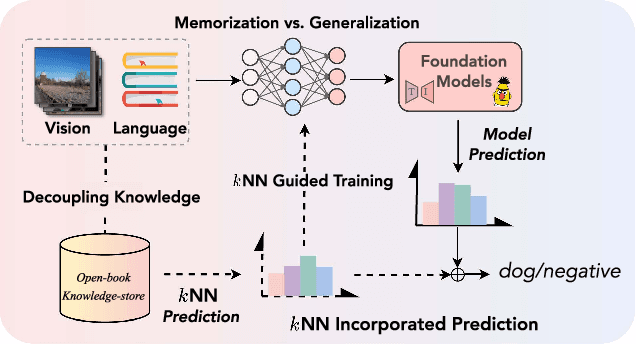
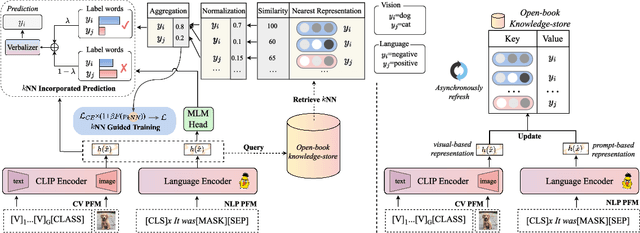
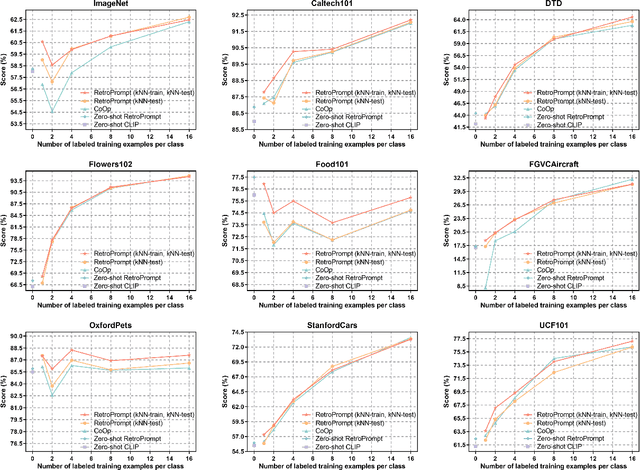
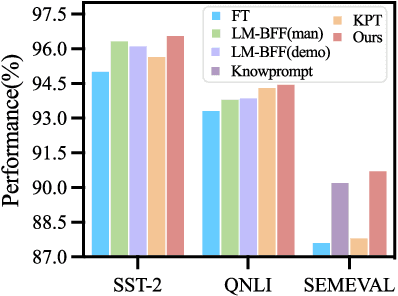
The pre-trained foundation models (PFMs) have become essential for facilitating large-scale multimodal learning. Researchers have effectively employed the ``pre-train, prompt, and predict'' paradigm through prompt learning to induce improved few-shot performance. However, prompt learning approaches for PFMs still follow a parametric learning paradigm. As such, the stability of generalization in memorization and rote learning can be compromised. More specifically, conventional prompt learning might face difficulties in fully utilizing atypical instances and avoiding overfitting to shallow patterns with limited data during the process of fully-supervised training. To overcome these constraints, we present our approach, named RetroPrompt, which aims to achieve a balance between memorization and generalization by decoupling knowledge from mere memorization. Unlike traditional prompting methods, RetroPrompt leverages a publicly accessible knowledge base generated from the training data and incorporates a retrieval mechanism throughout the input, training, and inference stages. This enables the model to actively retrieve relevant contextual information from the corpus, thereby enhancing the available cues. We conduct comprehensive experiments on a variety of datasets across natural language processing and computer vision tasks to demonstrate the superior performance of our proposed approach, RetroPrompt, in both zero-shot and few-shot scenarios. Through detailed analysis of memorization patterns, we observe that RetroPrompt effectively reduces the reliance on rote memorization, leading to enhanced generalization.
LightMem: Lightweight and Efficient Memory-Augmented Generation
Oct 21, 2025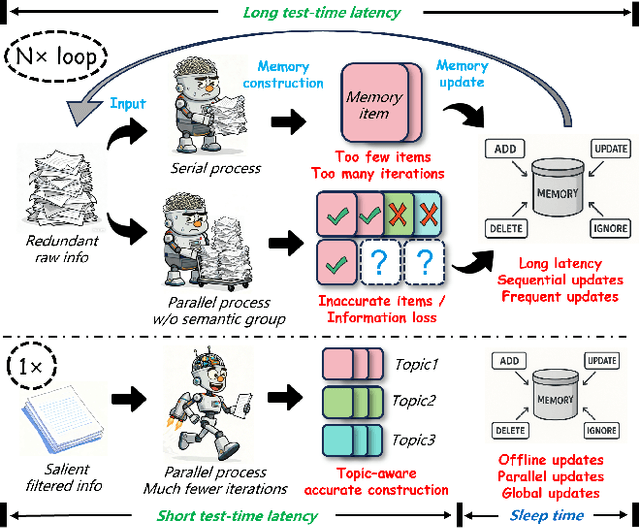
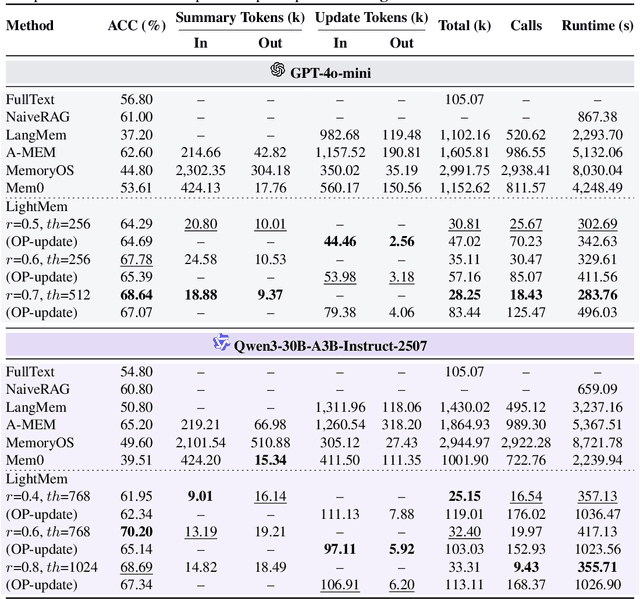
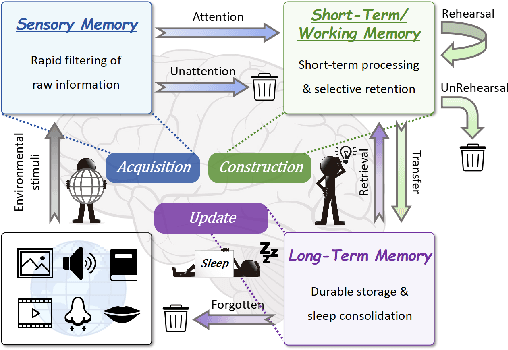
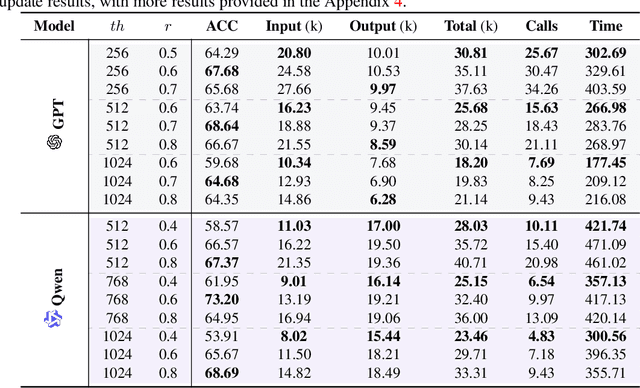
Despite their remarkable capabilities, Large Language Models (LLMs) struggle to effectively leverage historical interaction information in dynamic and complex environments. Memory systems enable LLMs to move beyond stateless interactions by introducing persistent information storage, retrieval, and utilization mechanisms. However, existing memory systems often introduce substantial time and computational overhead. To this end, we introduce a new memory system called LightMem, which strikes a balance between the performance and efficiency of memory systems. Inspired by the Atkinson-Shiffrin model of human memory, LightMem organizes memory into three complementary stages. First, cognition-inspired sensory memory rapidly filters irrelevant information through lightweight compression and groups information according to their topics. Next, topic-aware short-term memory consolidates these topic-based groups, organizing and summarizing content for more structured access. Finally, long-term memory with sleep-time update employs an offline procedure that decouples consolidation from online inference. Experiments on LongMemEval with GPT and Qwen backbones show that LightMem outperforms strong baselines in accuracy (up to 10.9% gains) while reducing token usage by up to 117x, API calls by up to 159x, and runtime by over 12x. The code is available at https://github.com/zjunlp/LightMem.
OceanGym: A Benchmark Environment for Underwater Embodied Agents
Sep 30, 2025We introduce OceanGym, the first comprehensive benchmark for ocean underwater embodied agents, designed to advance AI in one of the most demanding real-world environments. Unlike terrestrial or aerial domains, underwater settings present extreme perceptual and decision-making challenges, including low visibility, dynamic ocean currents, making effective agent deployment exceptionally difficult. OceanGym encompasses eight realistic task domains and a unified agent framework driven by Multi-modal Large Language Models (MLLMs), which integrates perception, memory, and sequential decision-making. Agents are required to comprehend optical and sonar data, autonomously explore complex environments, and accomplish long-horizon objectives under these harsh conditions. Extensive experiments reveal substantial gaps between state-of-the-art MLLM-driven agents and human experts, highlighting the persistent difficulty of perception, planning, and adaptability in ocean underwater environments. By providing a high-fidelity, rigorously designed platform, OceanGym establishes a testbed for developing robust embodied AI and transferring these capabilities to real-world autonomous ocean underwater vehicles, marking a decisive step toward intelligent agents capable of operating in one of Earth's last unexplored frontiers. The code and data are available at https://github.com/OceanGPT/OceanGym.
Memp: Exploring Agent Procedural Memory
Aug 08, 2025Large Language Models (LLMs) based agents excel at diverse tasks, yet they suffer from brittle procedural memory that is manually engineered or entangled in static parameters. In this work, we investigate strategies to endow agents with a learnable, updatable, and lifelong procedural memory. We propose Memp that distills past agent trajectories into both fine-grained, step-by-step instructions and higher-level, script-like abstractions, and explore the impact of different strategies for Build, Retrieval, and Update of procedural memory. Coupled with a dynamic regimen that continuously updates, corrects, and deprecates its contents, this repository evolves in lockstep with new experience. Empirical evaluation on TravelPlanner and ALFWorld shows that as the memory repository is refined, agents achieve steadily higher success rates and greater efficiency on analogous tasks. Moreover, procedural memory built from a stronger model retains its value: migrating the procedural memory to a weaker model yields substantial performance gains.